Author: Louis Vuylsteke

  • Our Brains Need to Get Back To Work

    Our Brains Need to Get Back To Work

    The law of least effort says that when a task can be solved in several different ways, over time, people gravitate towards the one that requires the least effort. Considering this theory, it makes sense that nearly everybody uses artificial intelligence to save time and effort. But that’s not the full story. This law does not tell us that completing a task in the way you have the least resistance is always the best way. It only describes a recurring phenomenon.

    AI can easily automate many tasks like summarizing reports, drafting emails, generating creative ideas, writing letters to customers, and so on, but the question is which tasks are better off being automated by AI and which are not?

    The Longer Way is Shorter
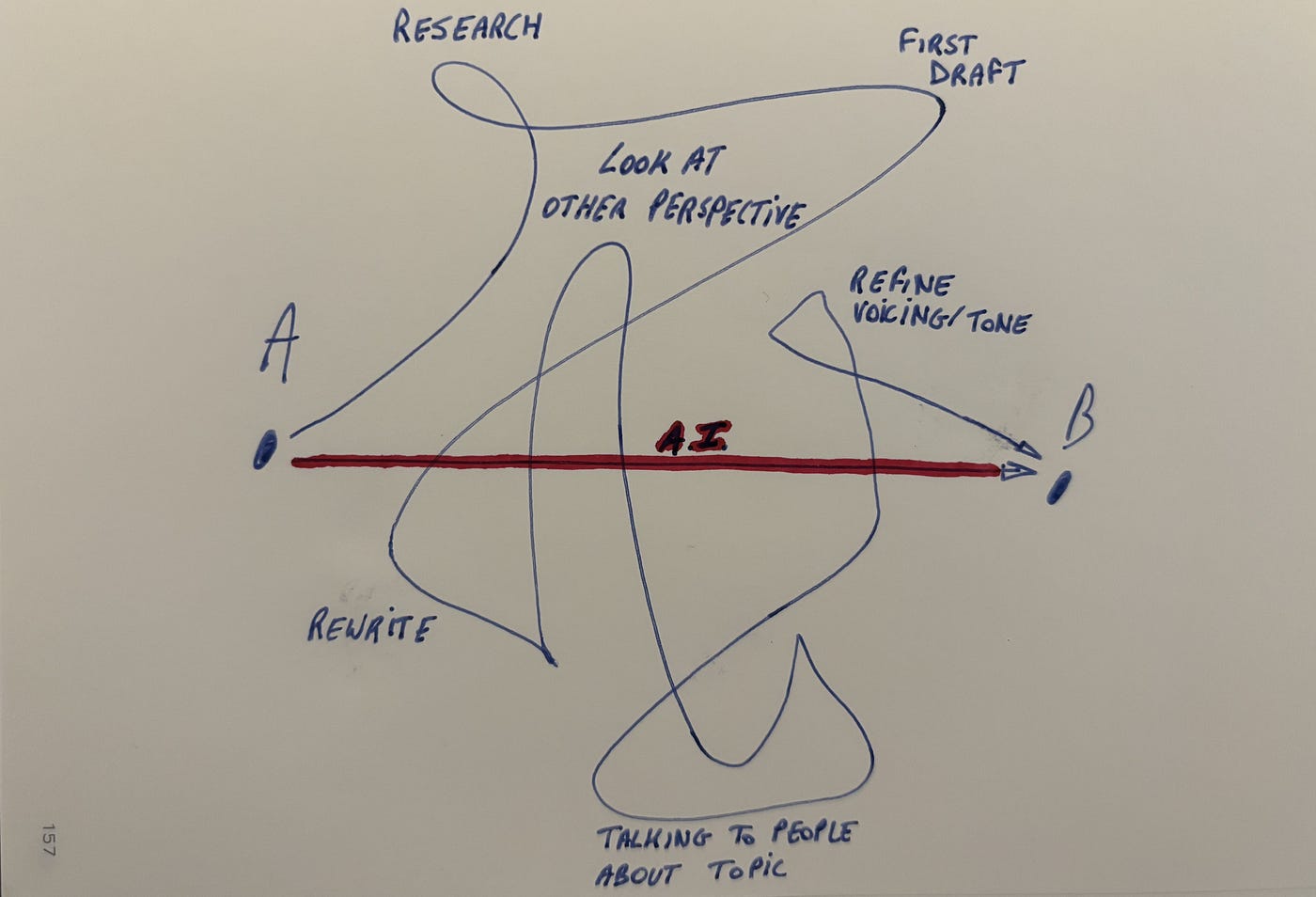
    My notebook: Using AI vs using our brain

    Take, for example, college students who have to write an essay. Many of them use AI for the majority of their writing process. I’ve done it myself, too. It makes sense; students use AI because it frees up so much time. AI is a free page-filler machine. But everybody knows that the world is not waiting for more college student essays; in fact, nobody cares about them. The only reason students need to write essays is to develop skills like critical thinking.

    The process of writing is: (1) gathering data and ideas; (2) processing and merging them logically together; and finally (3) writing them out. AI can replace all three stages. That is concerning. It’s like someone takes a plane from San Diego to New York and then pretends to have seen the entire United States. You save time, yes, but you miss all the valuable things along the way. By car, you might sometimes drive the wrong way, and it would certainly take much longer, but you would learn and remember a lot from the experience.

    I’m convinced that at the end of the day, the longer way is shorter.

    The feeling of hard work

    About a week ago, a friend told me he was writing his thesis and had already committed thirty pages of text to paper. Almost instinctively, I asked him if he wrote that all himself. His answer sounded so profound to me. He said, “Of course I did; how could I ever feel proud of my thesis if I didn’t put in the work myself?”

    I never really thought about it that way. Finishing an AI-generated text that you tried to humanize feels like hiding a crime; you hope nobody discovers it. You cannot enjoy the result. On the other hand, there is no better feeling than writing something yourself, working on it for days, and then finally handing it to the world. In the end, hard work is an essential element for our well-being and happiness.

    The authentic salesman

    As more and more people and students use AI for their emails and essays, it becomes increasingly easy to stand out with your self-written work. Generated texts all have the same format, language, and style of writing. That is because AI models don’t make any creative decisions. I was confused when my professor of data science told us one day that LLMs (Large Language Models) like ChatGPT only predict the next word in a sentence based on a large training set. No wonder generated texts all look so similar.

    I might be wrong; time will tell, but I truly believe that authentically written texts will be praised and cherished the more people use AI. Imagine a procurement department receiving dozens of AI-generated emails a day, while suddenly they receive an email from a salesman with a small personal anecdote from their last meeting together. Which email will have the greatest impact, you think?

    People love that intimate, personal connection, which AI simply cannot provide.

    The verdict

    Many tasks could be automated by AI. Especially those tasks that normally don’t require us to make lots of decisions: transferring data between platforms, generating invoices, sending automatic payment reminders, and so on. There is no doubt that AI can enhance productivity. My point, however, is that not every task that can be automated gets off better when automated. When automating a task that requires lots of decisions, like writing an essay, quality and authenticity inevitably get lost.

    Not using AI means falling behind; using AI for everything transforms us into thoughtless robots. A solution to not belong to either side is to use it intentionally. Is this task better off by using AI, or should I put my brain to work to produce something creative, personal, or original? Our brains can make out-of-the-box decisions that no AI tool can, and we should use this to our advantage.

    Doing something in the least effortful way possible is not necessarily the best way.

    “Responsibility to yourself means refusing to let others do your thinking, talking, and naming for you; it means learning to respect and use your own brains and instincts; hence, grappling with hard work.” — Adrienne Rich


  • The Art of Deep Listening

    The Art of Deep Listening

    A friend of mine studies in college in the same town as where I live. We don’t see each other that often. Roughly once a month. However, I know that when we meet, we’re going to have a good time together. We can talk on for hours about our ideas, struggles, or plans. No small talk or judgments. Just genuinely listening to one another. Few words are needed to understand each other. We have a different kind of conversation. That’s exactly what makes me look forward to every next time we meet.

    More heart to heart conversations

    Two old men sit and chat at a table outside a coffee shop in the city of Dürres, Albania.
    Source: Unsplash

    Conversations like I have with my friend make me ponder what distinguishes small talk from the more profound conversations. There are a couple of principles that helped me to have more meaningful conversations:

    1. Empathy is the crucial ingredient that binds everything together for a sincere conversation. Put yourself in the shoes of the speaker to understand what the person means with his words, how he is feeling, and what he wants. Sometimes we just nod and say, “Yeah, I get it,” while we just wait our turn to speak. Empathy requires careful listening.
    2. Asking questions about what people say is the best confirmation you can give the speaker that you really listen to them.
    3. Be honest and authentic. Some people always try to impress with the amount of money they make, the amazing party they were invited to last weekend, or how many job opportunities they got, and so on. Subconsciously, people do this to gain respect, but sooner or later, it backfires. Instead, when I’m in a conversation where a friend openly talks about her fears and frustration, that’s when I feel I can truly trust somebody. It is not realistic that everything goes well all the time. Everybody carries problems and fears within them; if we never talk about them, or we pretend you have no, we don’t gain any trust or respect. However, when we are honest and open to someone, they will often open up themselves too. This is the sweet spot where valuable conversations take place.
    4. As empathy is the binder of the dish, using someone’s name is the spice that finishes it off. Hearing our names makes us feel unique. Saying “thanks, Olivia” instead of “thanks” really makes a difference; the latter is way less personal, while the former immediately establishes a bond.

    “They may forget what you said — but they will never forget how you made them feel.” — Carl W. Buehner

    One Thing

    Paying close attention to what people say has some magical power that is overlooked by many of us. It creates a connection with someone. It gives them a sense of trust and respect in you. Just open your ears, be a genuine listener, and your conversations will not be the same anymore. Every story has a moral.

  • The Psychology of Beating the Market

    The Psychology of Beating the Market

    The premise of actively managed funds is that, with enough skill, it is easy to consistently outperform its index. This perspective was contested decades ago and resulted in an ongoing debate between passively and actively managed funds. The purpose of this essay is to investigate why people still think they can easily consistently outperform the market by using actively managed funds or stock picking, while the statistics show this is nearly impossible in the long run.

    The Data on Active Large Cap Underperformance

    To understand why it is almost impossible to outperform an index consistently, statistics are important. SPIVA (S&P Indices versus Active) operates a widely-used, semiannually updated database on how often actively managed funds in the United States underperform or outperform the S&P 500 index. It does this for a variety of countries and a variety of types of funds. I’ll use the United States as an example, but bear in mind that for other countries, results are similar.

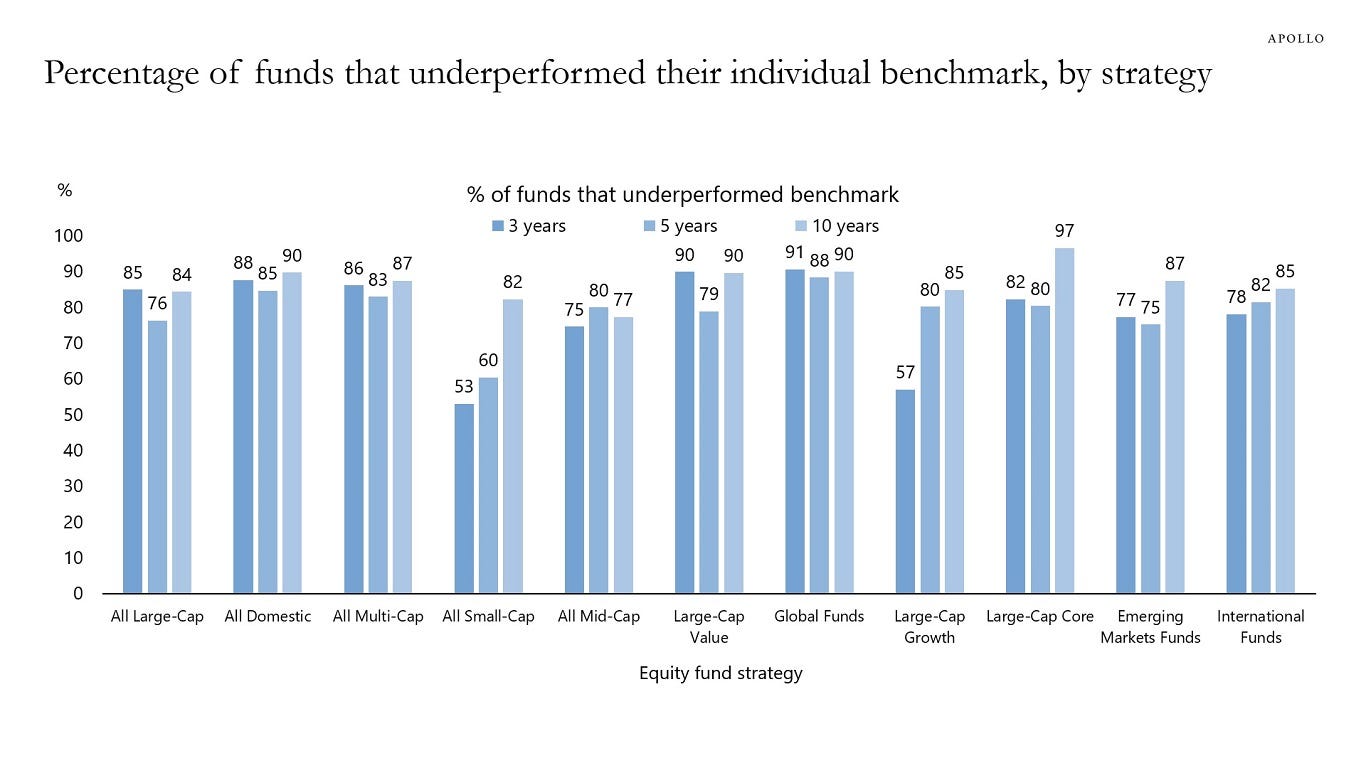
    Graph 1: SPIVA, Data as of Dec. 31, 2024

    As you can see on the above graph, in the US (Large-Cap):

    • over 1 year: 65.24% of funds underperformed the S&P 500; 34.76% outperformed the S&P 500
    • over 3 years: 84.96% underperformed; 15.04% outperformed
    • over 5 years: 76.26% underperformed; 23.74% outperformed
    • over 10 years: 84.34% underperformed; 15.66% outperformed
    • over 15 years: 89.50% underperformed; 10.50% outperformed

    This figure makes clear that outperforming the market is not that easy. Over one year, only a third of the active funds outperform the index, and things only get worse when the observation time increases. An important question is whether the 34.76% that outperformed the market realized this based on luck or by skill? A broken clock is right twice a day too. We all acknowledge that skill is consistent, while luck is not. To investigate the active managers premise that skill does the job, a look at the ‘Persistence Scorecard’ is necessary. This scorecard studies the top quartile active funds in one year and examines if they remain in the top quartile the consecutive years. In other words, it measures if top-performing active funds keep on performing in the next few years.

    Table 1: SPIVA, Data as of Dec. 31, 2024

    The upper table examines the top quartile funds (in terms of performance) and what percentage remains in this quartile the next one to five consecutive years. The bottom one does the same but for the top half performance funds. It is noticeable that funds that are in the highest quartile of performance and remain in that quartile for another two consecutive years (or longer) are almost nonexistent. The same goes for the bottom table, where a similar steep downhill trend is present.

    Regarding these stats we can conclude that:

    1. The percentage of funds that persist in their performance is so low that consistent outperformance can be considered extremely rare.
    2. Past success does not guarantee future results.
    3. The question whether luck is at play is solved.

    There is something that I need to clarify. A logical error I made myself too. The fact that 10% outperform the S&P 500 over 15 years is not a proof that a minority of skilled people consistently outperform. Not at all. Table 1 gives the answer to this misleading fallacy, as performance is not persistent. Those 10% are never the same people or funds. You can do it once, but nearly never consistently, and that is the essence of this essay.

    Finally, it is crucial to mention that only equity funds are incorporated in the statistics; these are professionally operated. What if amateur individual investors that often have little financial literacy were included in the statistics? Does anyone believe they would look any better?

    Why try to beat the market then?

    A reasonable question to ask is: Why do people still believe that by analyzing and picking stocks, they will perform better than the market?

    “Few investors realize that they are their own worst enemy.” — Tertius Liebenberg

    One word: Emotions.

    We all think we know what we are doing and that it is better than what other investors do, but there are at least two reasons why that’s not the case:

    1. The financial market is a place driven by irrational people with emotions, impulses, and their own belief of how things work.
    2. You don’t know what you don’t know. This implies that you always misinterpret your risk.

    I have no desire to speak pejoratively about people’s actions, but I assume ego plays a major role in why people keep investing in stocks with the romantic idea of seeing it skyrocketing one day. Illusory superiority is what pushes most investors towards trying to outperform indexes. We believe we are above average and are part of the small minority of investors that can outperform. This is often a subconscious belief, which makes it even more dangerous.

    “…while enthusiasm may be necessary for great accomplishments elsewhere, on Wall Street, it almost invariably leads to disaster.” — Benjamin Graham

    We are human beings: full of emotions and easily enticed by cognitive biases and fallacies. One important bias in investing is “loss aversion.” We tend to give more value to the loss of something than we put value to the joy of an equivalent win. This is a natural human defense mechanism. If you comprehend this bias, you understand why people sell in panic. Many other examples could be given, but you get the point. We are human.

    The Effort-Return Trap

    Frequently, I read and hear skepticism about the lazy EFT-investor, but looking at the numbers (see graph 1), who will prove him wrong? There is not a single study that shows there is a link between effort and return in investing. This is not intuitive because in most human fields, the more effort you put into something, the better your results will be. Think of a plumber repairing more toilets a day and, as a result earns more. Not in investing. This is what I call the Effort-Return Trap. Once you understand this, you can save yourself time and worries.

    Get the odds on your side

    You can beat the market once or maybe twice, but doing so consistently is extremely rare and highly unrealistic. When I talk with people about the extremely low chances of beating the market, they always point me to the fact that “tons of people” did it before: Peter Lynch, Warren Buffett, and so on. But this is a perfect example of the availability bias.

    You’ll only hear the extremely good or terribly bad stories, but never the story of the average man in the street. Of course there are people that can beat the market more or less consistently, but this is such an extremely (negligible) small minority. Stories of extraordinary investing returns lead us into believing it is the reality, and we can do the same without much effort.

    In my view, there is a simple two-step trick that increases your chances of investing success over time massively:

    Agree with the average. This requires a mentality shift from chasing performance towards avoiding losses. And remember: once you get greedy, you lose money. Investing with greed is indistinguishable from gambling. And the best strategy in gambling is to get out of the casino as soon as you enter.

    Increase your time horizon. There is nothing more powerful in investing as time. The fee you pay for time is patience and uncertainty.

  • So, I Decided to Write

    So, I Decided to Write

    It has been in my mind to write down my ideas and publish them publicly for a while now. Some invisible power held me back every time. What will you write about? How will you ever write a proper essay? What will people think of you putting scattered thoughts on paper? A power strong enough to reduce the desire back to a mere wishy wooshy dream. Not until today.

    “The art of writing is the art of discovering what you believe.” — Gustav Flaubert

    As I have been penning down my ideas in my little notebook for a while now, I realized that merging together thoughts into a handful of sentences on paper brings clarity. It’s just like a magical power. Thoughts and emotions start to make sense when you take a moment to think twice about them.

    “I write one page of masterpiece to ninety pages of shit.” — Ernest Hemingway

    The worst excuse I could use for not writing is that I don’t know how to write an essay. Of course I know how to write. I just don’t know how to write in a smooth and attractive manner. Time will help me out with that; I am optimistic. The best moment to start writing was probably years ago, but the second-best day is today. This introductory essay is my starting point.

    To be true to myself and the readers putting effort in reading these works, I need to make some basic rules to myself:

    1. Writing without honesty is madness. I write as if nobody will ever read these essays.
    2. As a way of staying consistent, I will publish a minimum of one essay a week.
    3. I solely write about what I truly care about.
    4. All I ever write is written by myself. A human.

    The ultimate goal for me is to inspire others with my ideas and have some discussion. But that is not in my control. Anyway, this will be a personal storage room for my ideas and whoever want to read them can.